tiny Spectrum Analyzer
Hello everyone. This post will be a brief overview of a new tool I just received. This is the tinySA tiny Spectrum Analyzer Ultra+. So far, it’s a cool little device. My use for it will be in occasional field work when setting up wi-fi radios, and checking background RF interference. I have a mobile frequency counter, that can do some of what the analyzer can – but not all.
The version I have is the ZS407 – with a frequency range of 100kHz to 7.3GHz. Up to 900MHz in normal mode, it’s really pretty quick. As you might imagine, when Ultra mode is enabled, the scans slow down quite a bit. The analyzer specs are as follows (from the tinySA webpage:
- Input frequency range from 100kHz to 800MHz (900 MHz for Ultra+) in normal mode and up to 6GHz ( 7.3GHz for ZS407 ) with ULTRA mode enabled
- Input impedance 50 ohm when input attenuation set to 10dB or more.
- Selectable manual and automatic input attenuation between 0dB and 31dB in 1 dB steps when LNA not active
- Maximum +/-5V DC input
- Absolute maximum input level of +6dBm with 0dB internal attenuation
- Absolute maximum short term peak input power of +20dBm with 30dB internal attenuation
- Suggested maximum input power of +0dBm with internal attenuation in automatic mode
- For best measurements keep input power below -25dBm
- Input Intercept Point of third order modulation products (IIP3) of +15dBm with 0dB internal attenuation
- 1dB compression point at -1dBm with 0dB internal attenuation
- Power detector resolution of 0.5dB and linearity versus frequency of +/-2dB below 5.3GHz, +/-5dB between 5.3GHz and 6GHz
- Minimum burst length for correct level measurement at 850kHz RBW in zero span mode of 50 microseconds
- Absolute power level accuracy after power level calibration of +/- 2dB
- Built-in optional 20dB LNA with Noise Figure of 5dB up to 4GHz ( 6 GHz for ZS407)
- Lowest discernible signal without LNA at 30MHz using a resolution bandwidth of 30kHz of -102dBm
- Lowest discernible signal with LNA at 30MHz using a resolution bandwidth of 200Hz of -145dBm
- Frequency accuracy equal to the selected resolution bandwidth
- Phase noise at 30MHz of -108dB/Hz at 100kHz offset and -115dB/Hz at 1MHz offset
- Spur free dynamic range when using a 30kHz resolution bandwidth of 70dB
- Resolution filters with a width of 0.2, 1, 3, 10, 30, 100, 300, 600 and 850 kHz.
- On screen resolution of 51, 101, 145, 290 or 450 measurement points.
- Scanning speed of over 1000 points/second using largest resolution filters.
- Automatic optimization of actual scanning points to ensure coverage of the whole scan range regardless of the chosen resolution bandwidth
- Spur suppression option for assessing if certain signals are internally generated or actually present in the input signal
- Headphone output for listening to the demodulated audio (AM only). Stereo connector with or without microphone, high impedance is louder, short protected
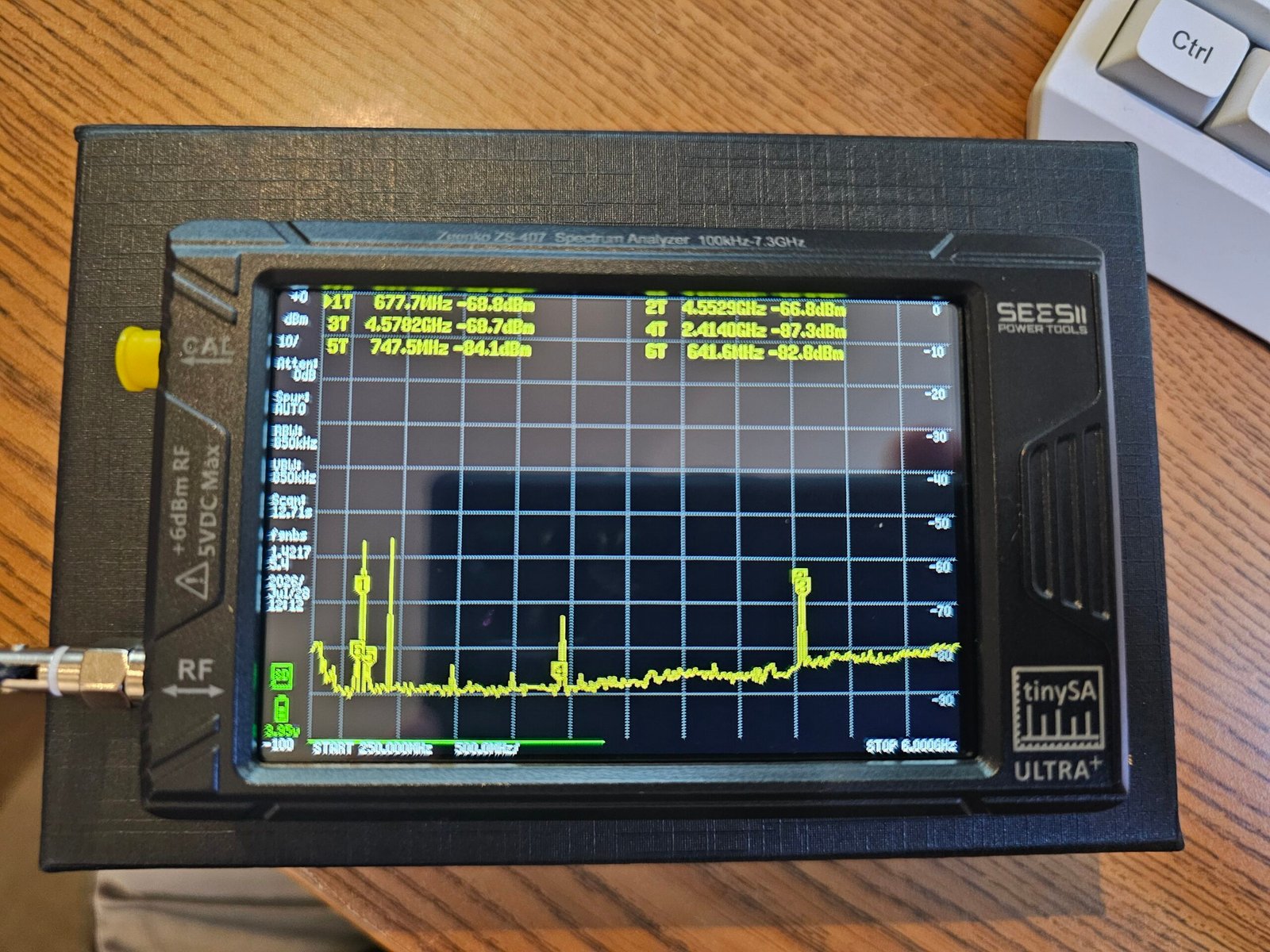
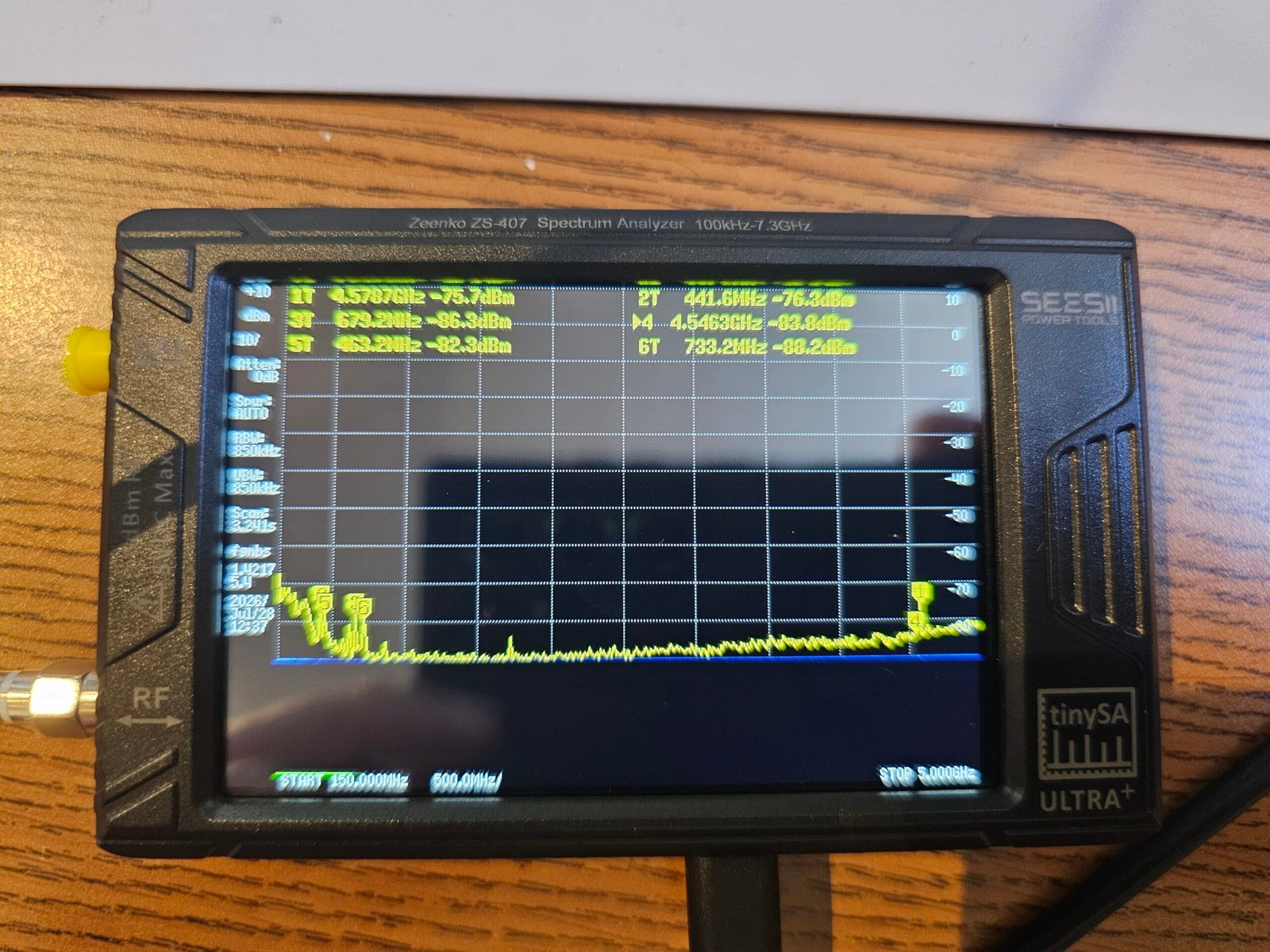
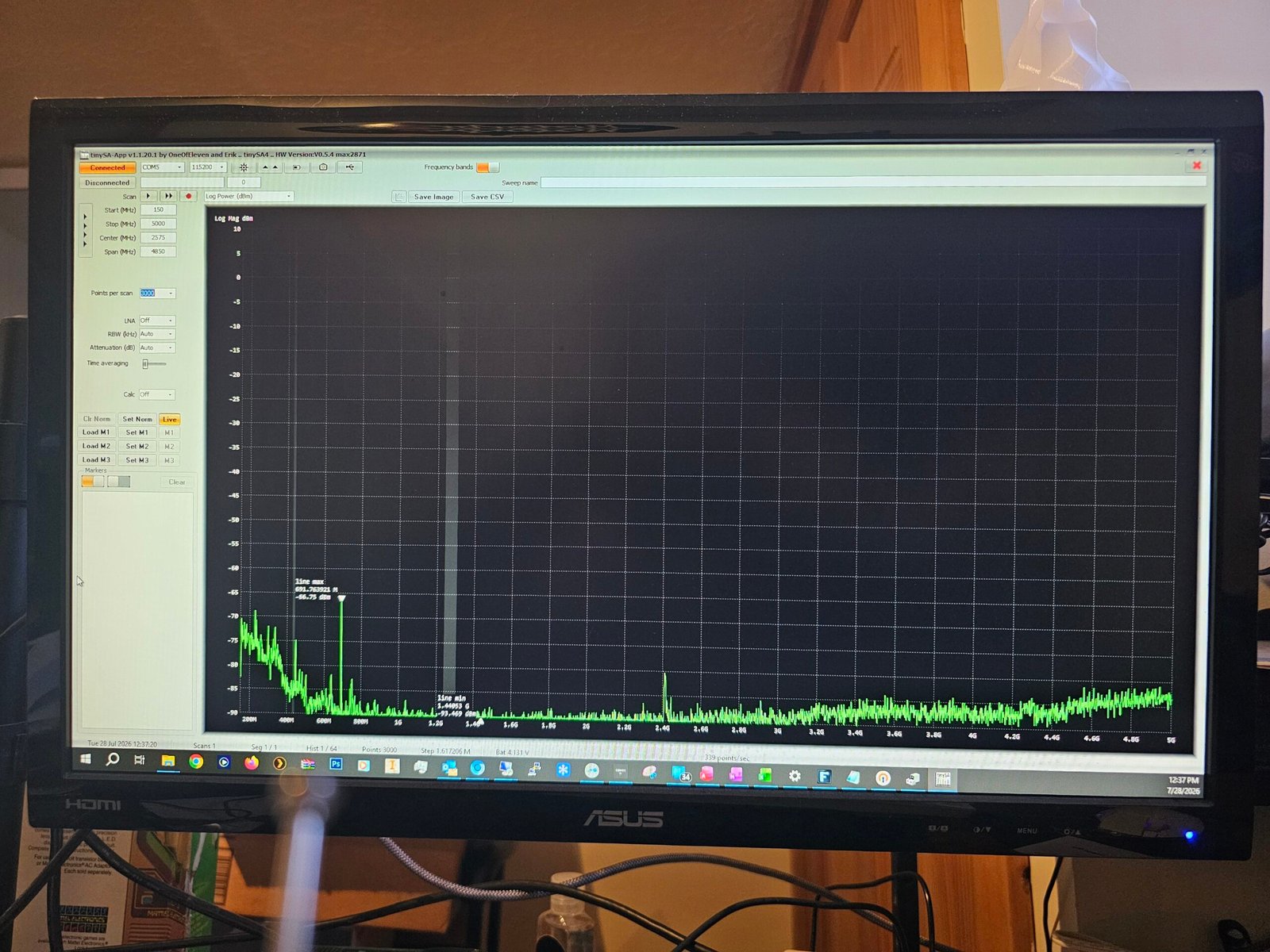
This isn’t meant to be a full blown review, though I may get to one at some point. In my brief time playing with it, I’ve found it to be a capable tool for what I need. It was able to pick up my 2.4G, 5G and 6G wi-fi access points, as well as a few of the Ubiquiti PtP radios in use here. I also like that it can be tethered to a PC (Windows or Linux) for a larger view, and control. I need to delve into the application docs for some more detail, but you can see some of the operation in the images in this post.
I’m sure as time goes by, more content will appear with this device in use. Until next time…. carry on.